Overview:
In the beginning of this project, we were assigned teams and a problem space to find a solution for. Our defined problem space was professional self-development. This project is focused on user experience design, and utilizes the design thinking process. The end result of this project is a low-fidelity prototype of a solution created using said process.

Team:
4 other UX Designers +  me

Role:
UX Designer

Hypothesis: Students lack meaningful networking.
Icon of two chairs with a table under an umbrella
Experiment: An app that connects students with recruiters.

Observation

Since our problem space was professional self development, we focused on young college professionals. We observed that young college professionals struggled in the recruitment process.

Gather Background Info

User Research

I relied on retrospective interviews to understand what the most ‘stand out’ experiences are, and hear how users felt at particular points in the recruitment process and what they did.
I was able to interview two college seniors. Both took had very different approaches on how to approach the job search process. However, both had a strong dislike for online networking sites

Participant Profiles

Seniors in Computer Science
Both have internship experience
Varying company size experience
Strong dislike for online networking

User Motive Analysis

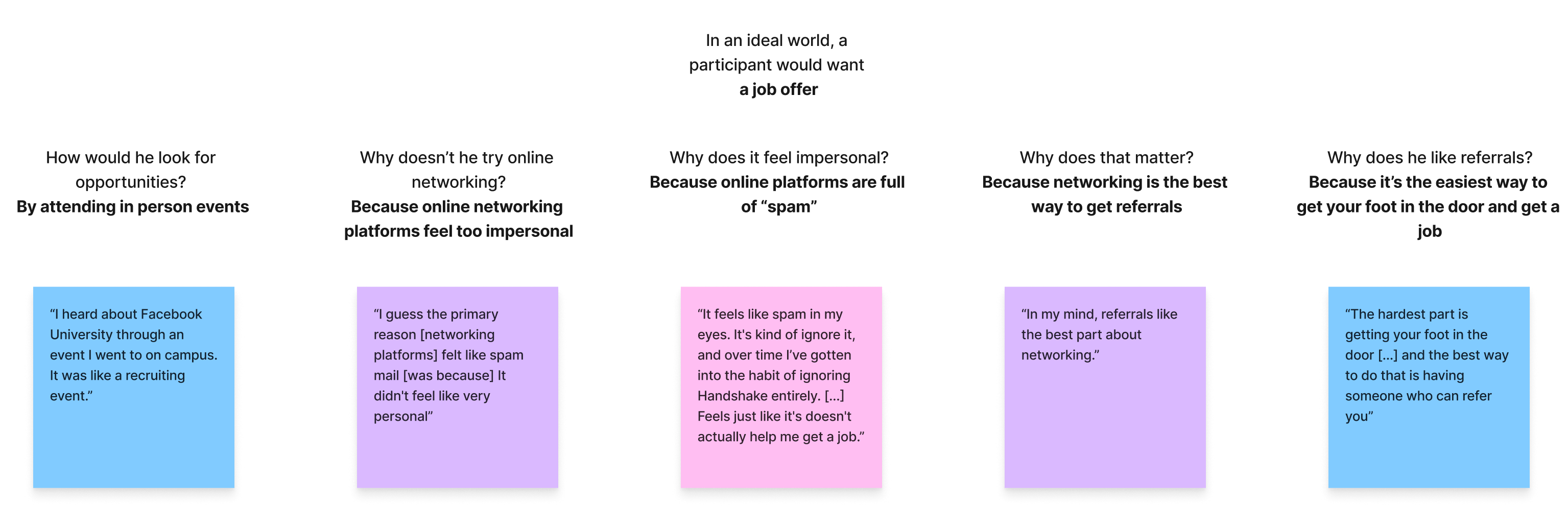
It's important to understand our user's motivations, and their feelings about the job searching process. From the interviews I conducted, I was able to understand why my participants took the actions they did in order to achieve their goals.
Image of user analysis of participant 2's user interview.

User Journey Mapping

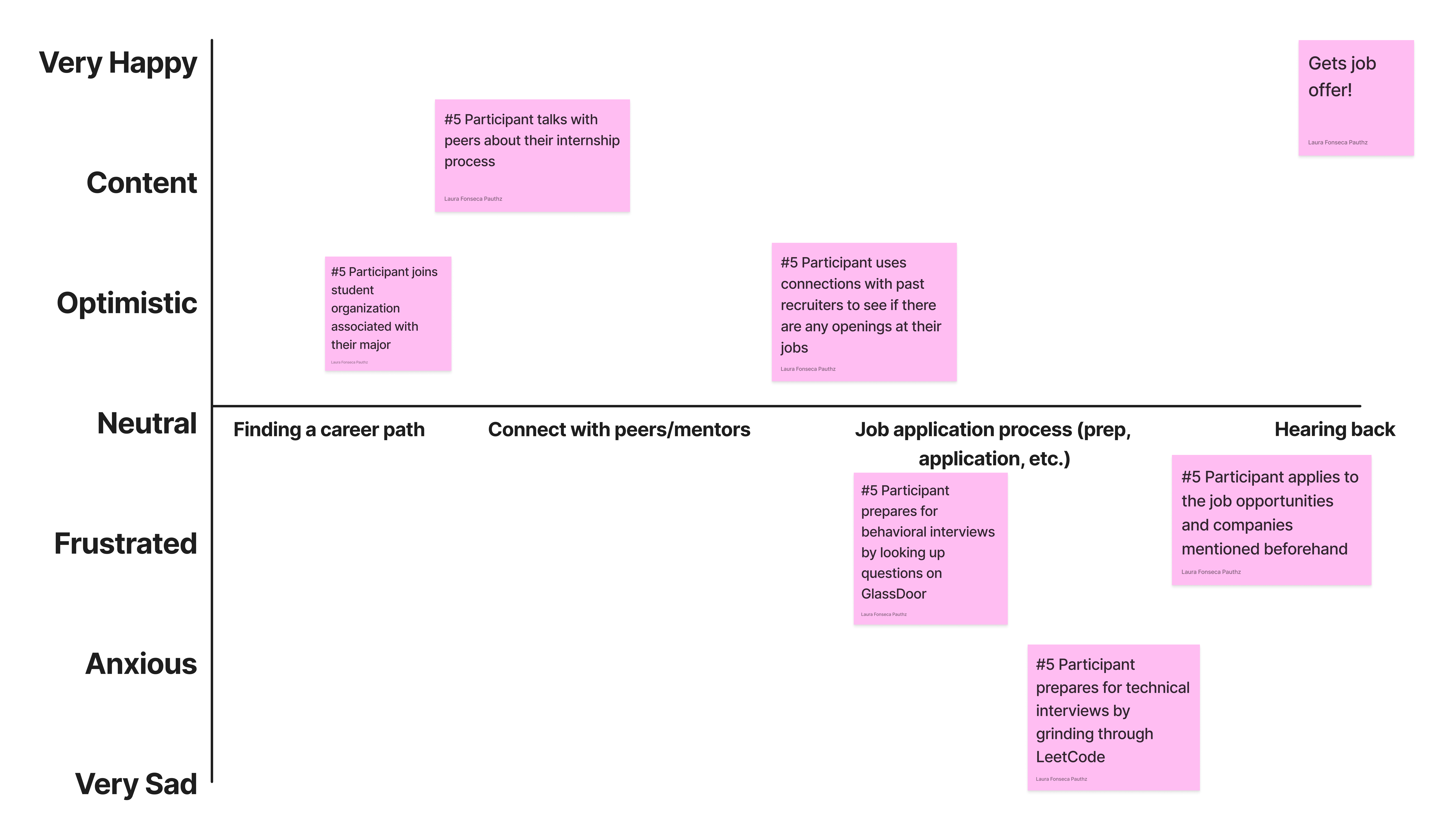
After gathering thematic patterns across our participants, we also had to analyze how our participants felt throughout the job application process. We utilized a user journey map, and our participant's data to put together our participants' emotions as they try to achieve their goal (obtaining a job).
Many of the complaints and stressors come from the fact that our users do not know how to socialize in the context of networking, which makes them feel anxious and very sad.
Image of a user journey map which shows how my user research participants felt during their time as students finding their career paths and applying for jobs.

Create a Hypothesis

If students have more opportunities to build natural connections, then they will feel more confident and build better connections.

The Personas

Based off what we learned from all of our participants, we were able to create personas: Abby and Peter.
We focused on having personas that are either experienced (Abby) or inexperienced (Peter) in order to find a solution that appeals and works for all types of college professionals.

Defining the Problem

Users wanting to build natural and deeper connections was a theme that was unique, unexpected, solvable, and (most importantly) backed by evidence. From this, we are now able to properly define our problem, and frame it around Abby and Peter.

👩🏻‍💻 Abby, 21, CS Major

🧑🏽‍🦰 Peter, 22, OR Major

Factors that influence behavior
Needs, obstacles, and desires
  • Has internship experience
  • Applies to jobs with and without referrals from connections
  • Searched jobs in on-campus events
  • Created LinkedIn account freshman year
  • Wants full-time job after graduating
  • Wants to learn about new opporunities
  • Overwhelmed by multiple career paths
  • Unsure how to properly network

Test Hypothesis

Design Goals

Before stepping to find the right solution, it's important to set a clear goal now. Being able to draw an explicit line on when the problem has been solved (or at least enough) by outlining specific evaluation criteria is a great way from becoming too ambitious.
Improve the quality of conversations at networking events
Lower barriers in events to decrease stress in networking
Increase accessibility to informal networking events.
Peter feeling more confident when applying.
Abby learning more about her interests first-hand.
Abby and Peter feeling satisfied over the quality of connections.

Gaming: The solution?

After iterating through different approaches that ranged from matchmaking apps to apps that teach tailored skills, we ultimately chose a gaming approach to motivate students to improve their professional skills through tasks and rewards that lead to meeting a recruiter. With this design, we tried to tackle two problems at once: the need for meaningful connections and the struggle of getting your foot through the door.

Gaming: Not the solution

As we advanced through this project, we became too ambitious, losing sight of what really mattered and letting Abby and Peter slip from the forefront of our solution. We aimed to build something innovative but ended up with something common. So, we retraced our steps and realized we got off track when choosing our design solution. The crux of our problem is the lack of genuine connections—what design solutions could help us tackle that issue?
We developed a mobile app that matches students with local recruiters and industry professionals based on their professional interests. While meeting recruiters doesn’t guarantee job interviews, it offers students a chance to network and build meaningful relationships in a low-stress environment. The app presents students holistically, pairing them with others who share niche talents and facilitating informal meetups.
Flowchart of finding the best solution.

Core problem is lack of genuine connections

Possible solution 1 is matchmaking app for mentor and mentee

Possible solution 2 is making opportunities for bonding/informal conversations

Both solutions converge to the best solution which is a match making application between industry professionals and prospective applicants to just meet up and chat.

Analyze Results

Evaluating our solution

When we first created solutions, we went the wrong way  because we tried to find ways to fix the job hunting process as a whole. Matched! only guarantees that a student meets face-to-face with a recruiter/professional that specializes in the student's interests.
In matching students with professionals, students are not only able to form genuine connections, but they are also able to present themselves holistically and improve their networking skills in the process!

How Matched! meets design goals

Peter can talk to professionals in his field
Abby can find a company she likes
Abby and Peter feel satisfied over their connections

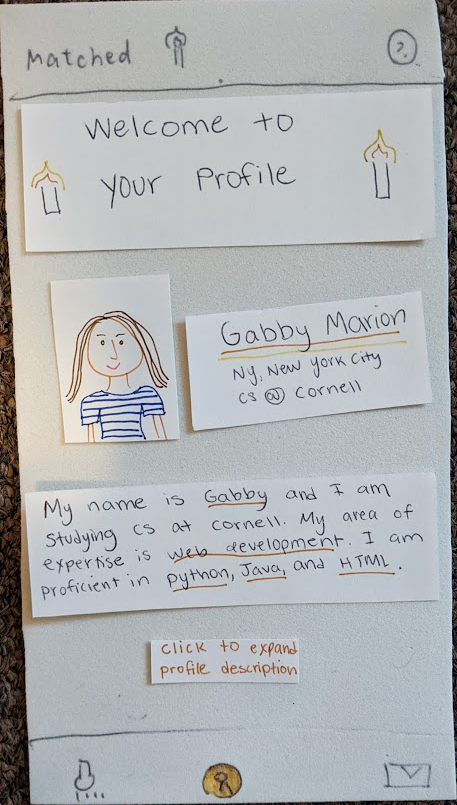
Paper Prototyping

Our application is a novel approach in promoting informal and natural connections between recruiters and students. We want to help users understand that this app is meant to facilitate in-person networking rather than guaranteeing a job interview. Therefore, we aim to make our users focus on the quality of the networking relationship they need rather than the quantity of networking relationships they want.

How the app works

Sign up and add basic information
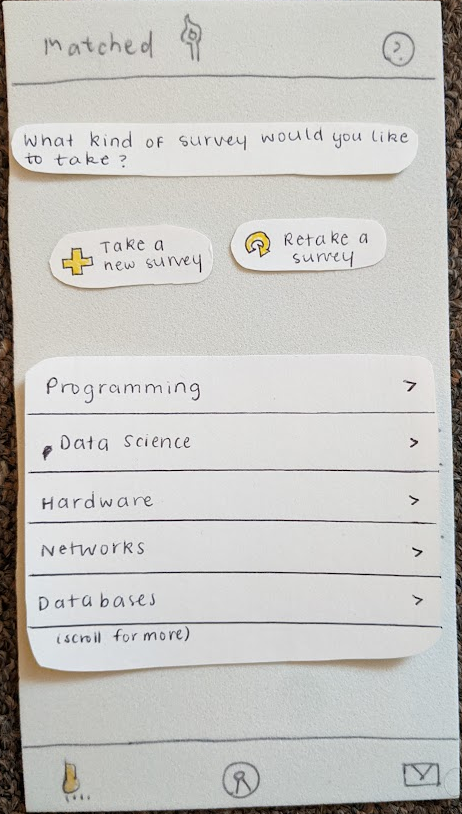
Fill out quiz for a particular topic
The app will match you to a local recruiter or professional
Meet face-to-face

Prototyping Results

Prototyping results: During our final day of classes, we were able to test out our prototype during a prototype showcase. We found that our app was pretty easy to navigate through, but found some areas of improvement:
  • Clearer Iconography: Users were confused over a lightbulb icon being used for [Surveys], got changed to a pencil and paper icon.
  • Improved Hierarchy: Move match results to the inbox page so users find previous matches faster.
  • Expanded Questions: Added behavioral questions to highlight user soft skills and their understanding of theories and practices instead of just technical skills.

Considerations and Conclusions

KPIs and Future Features

At launch, these would be the KPIs I'd monitor to consider its success at launch and shortly after:
  • DAU/MAU: Track the usage among users through time. Consider trends in usage to boost engagement.
  • Match Success Rate: Monitor the matches made, prioritize new and unique matches over repeats.
  • App Ratings: Gauge overall user satisfaction.
Further considerations would include recruiter/professional-side incentives, and implementation.

Conclusion

This project took a lot of time and effort from everyone in the team, and even though it got very stressful at some points, it was such a rewarding experience and taught me so much about the user-centered design process:
  • Your persona may be fake, but their needs are not:
    One of the most frustrating parts of this entire project was when we began to divert away from our personas, and began to morph our project into a cure-all for the job hunting process. Once we realized we strayed by not focusing on our user, it was so much easier to find a solution that was geared for them.
  • Take more time on the problem than the solution:
    Finding the problem doesn't just mean listen to complaints, it means digging deeper and finding out the why. Asking this crucial question can change a solution from something very basic at best and inconvenient at worst to something innovative and actually helpful.
  • Planning, and setting goals/expectations early leads to success:
    Planning early is beneficial since the problem and user needs are fresh in your mind. Planning for evaluation criteria while or after designing would not be as effective since you are so focused on finding solutions and making designs. Much like your personas/users, your expectations (which are rooted on your user's needs) should also be your guiding light!
That was a lot! Jump to top?